
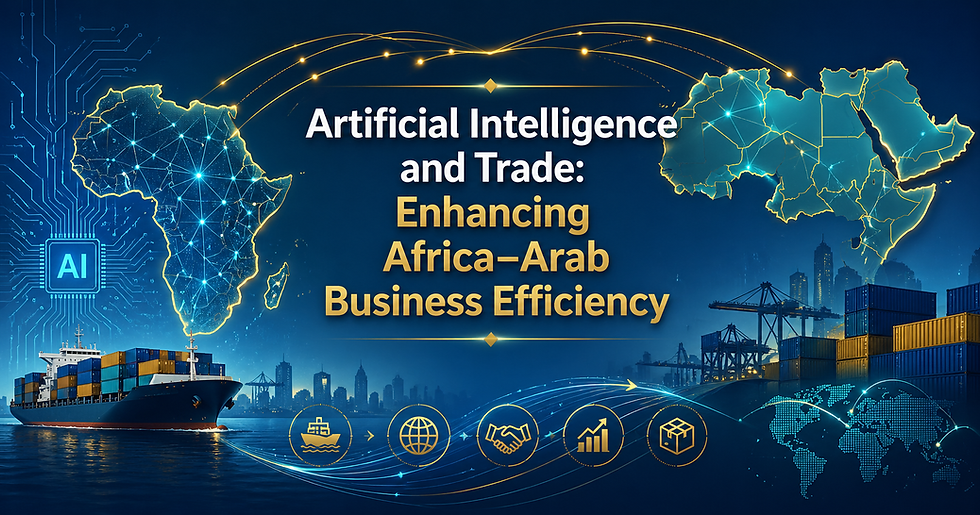
Artificial Intelligence and Trade: Enhancing Africa–Arab Business Efficiency
Trade between Africa and the Arab world has always been built on strong historical ties, shared geography, cultural understanding, and growing economic cooperation. From agriculture and food security to logistics, energy, construction, tourism, finance, and digital services, the relationship between African and Arab markets continues to create new opportunities for businesses of all sizes.
Today, artificial intelligence is adding a new dimension to this partnership. AI is no longer only a topic for large technology companies. It is becoming a practical tool that can help chambers of commerce, exporters, importers, investors, logistics companies, banks, manufacturers, and small businesses work faster, smarter, and more efficiently.
For the Joint Kenya-Arab Chamber of Commerce and Industry, this development is important because AI can support stronger business links between Kenya, the wider African continent, and Arab markets. Used responsibly, AI can improve trade communication, reduce delays, support better decision-making, and make cross-border business more accessible.
AI as a Tool for Better Trade Decisions
One of the most valuable uses of artificial intelligence in trade is data analysis. Businesses often need to understand market demand, pricing trends, customer behavior, product movement, and regional opportunities. In the past, collecting and analyzing this information could take a long time and require significant resources.
AI can help companies study large amounts of information more quickly. For example, an exporter in Kenya may use AI-supported tools to understand which agricultural products are gaining demand in Gulf markets. A logistics company may use AI to predict transport delays or recommend better routes. An investor may use AI-based reports to compare opportunities in different sectors.
This does not replace human business judgment. Instead, it strengthens it. Business leaders still need experience, local knowledge, relationships, and cultural understanding. AI simply provides better information to support more confident decisions.
Improving Export and Import Processes
International trade involves many steps: documentation, customs procedures, product classification, shipping schedules, compliance requirements, payments, and communication between different parties. These steps are necessary, but they can sometimes slow down business.
AI can help simplify many of these processes. Smart digital systems can support document preparation, detect missing information, translate business communication, organize shipment data, and help companies understand regulatory requirements. This can reduce errors and save time.
For small and medium-sized enterprises, this is especially useful. Many SMEs have strong products and services but limited administrative capacity. AI tools can help them prepare for export markets, communicate with international buyers, and manage business operations more professionally.
By reducing complexity, AI can make Africa–Arab trade more inclusive. More businesses can participate, not only large companies.
Supporting Communication Across Languages and Markets
Africa and the Arab world are rich in languages and cultures. English, Arabic, Swahili, French, Somali, Amharic, and many other languages are part of daily business life across the regions. This diversity is a strength, but it can also create communication challenges.
AI-powered translation and communication tools can help companies connect more easily. A Kenyan business can prepare product information in Arabic for potential buyers. An Arab investor can understand market information from African partners more quickly. Business chambers can use digital tools to support smoother communication between members.
Good communication builds trust. When businesses understand each other clearly, partnerships become stronger, negotiations become easier, and long-term cooperation becomes more likely.
Making Logistics and Supply Chains More Efficient
Efficient logistics are essential for successful trade. Goods must move safely, quickly, and at the right cost. AI can help improve supply chain planning by predicting demand, identifying risks, tracking shipments, and improving warehouse management.
For Africa–Arab trade, this is highly valuable. Many goods move through ports, airports, roads, and free zones. AI-supported systems can help businesses plan better routes, estimate delivery times, reduce waste, and respond faster to unexpected disruptions.
In sectors such as agriculture, flowers, tea, coffee, fresh food, pharmaceuticals, and manufacturing, timing is very important. Better logistics can protect product quality and increase customer satisfaction.
Helping SMEs Become More Competitive
Small and medium-sized enterprises are the foundation of many African and Arab economies. They create jobs, support families, encourage innovation, and bring local products to international markets.
AI can give SMEs access to tools that were once available only to larger companies. These tools may include customer service chatbots, automated marketing, inventory planning, financial forecasting, digital translation, and market research support.
For example, a small Kenyan producer may use AI to improve product descriptions, prepare export documents, understand customer preferences, or identify suitable distributors in Arab markets. A small Arab trading company may use AI to search for African suppliers, compare prices, and manage communication with partners.
This can make trade more balanced and more accessible. When SMEs are supported, economic growth becomes wider and more inclusive.
Encouraging Innovation and Youth Participation
Africa and the Arab world both have young, dynamic populations. Many young people are skilled in technology, entrepreneurship, digital marketing, logistics, finance, and creative industries. AI can help open new career and business opportunities for this generation.
Young entrepreneurs can create AI-based trade platforms, digital marketplaces, logistics solutions, payment tools, and business intelligence services. These innovations can connect African producers with Arab buyers and Arab investors with African opportunities.
The future of Africa–Arab trade will not only depend on traditional business sectors. It will also depend on digital innovation, startups, and young professionals who understand both technology and international commerce.
Responsible and Human-Centered Use of AI
While AI offers many benefits, it should be used responsibly. Businesses must protect data, respect privacy, avoid unfair practices, and ensure that technology supports people rather than replacing them without planning.
Trade is still based on trust, relationships, ethics, and professionalism. AI can improve efficiency, but human values must guide its use. Chambers of commerce, business associations, governments, and private companies all have a role in promoting responsible digital transformation.
Training is also important. Business owners and employees need to understand how to use AI tools correctly. With proper awareness, AI can become a positive partner in business growth.
A Stronger Future for Africa–Arab Trade
Artificial intelligence is creating new opportunities to make Africa–Arab trade faster, smarter, and more connected. It can support better market research, smoother communication, stronger logistics, improved export processes, and greater participation by SMEs.
For Kenya and Arab markets, this is a promising moment. Kenya has a growing digital economy, strong entrepreneurial energy, strategic access to East Africa, and important trade sectors. Arab markets offer investment capacity, logistics strength, consumer demand, and regional business networks. Together, these strengths can create a powerful platform for future cooperation.
The Joint Kenya-Arab Chamber of Commerce and Industry supports the idea that technology should serve business, people, and sustainable economic growth. By embracing AI in a responsible and practical way, Africa and the Arab world can strengthen trade efficiency, build deeper partnerships, and create shared prosperity for the future.
References
World Trade Organization reports on digital trade and trade facilitation
United Nations Economic Commission for Africa publications on African trade and digital transformation
International Trade Centre publications on SME competitiveness and export development
African Union documents on digital transformation and regional economic integration
World Bank publications on logistics, technology, and private sector development


Comments