
The Role of Strategic Alliances in Driving Economic Growth
Strategic alliances have become one of the most important tools for supporting economic growth in today’s connected world. For countries, companies, chambers of commerce, investors, and entrepreneurs, cooperation is no longer only a choice. It is a smart path toward stronger trade, wider markets, better innovation, and long-term development.
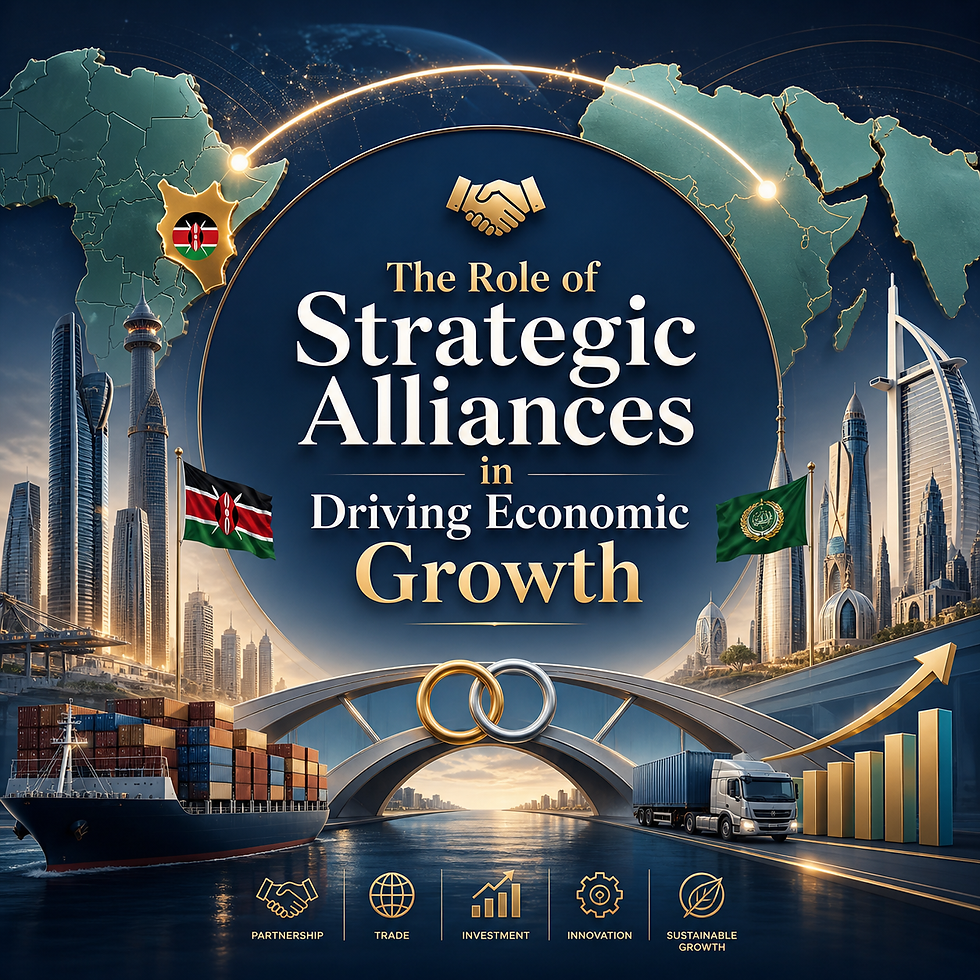
For Kenya and the Arab world, strategic alliances offer a powerful opportunity to build deeper economic bridges. Kenya has a dynamic economy, a strong geographic position in East Africa, a growing private sector, and access to regional markets. Arab countries bring strong investment capacity, advanced infrastructure experience, global trade connections, energy leadership, and growing interest in Africa’s future. When these strengths come together, they can create practical benefits for both sides.
A strategic alliance can take many forms. It may be a partnership between companies, cooperation between governments, joint investment projects, trade agreements, knowledge-sharing programs, or collaboration between chambers of commerce. The main idea is simple: each side brings its strengths, and together they achieve more than they could alone.
One of the strongest benefits of strategic alliances is trade expansion. When Kenyan and Arab businesses work together, they can open new markets for agricultural products, food processing, tourism, logistics, construction, technology, education, healthcare, and professional services. Kenya can benefit from stronger access to Arab markets, while Arab investors and businesses can benefit from Kenya’s position as a gateway to East Africa.
Strategic alliances also support investment. Many sectors in Kenya are ready for growth, including infrastructure, renewable energy, real estate, manufacturing, agribusiness, transport, digital services, and hospitality. Arab investors can find strong opportunities in these areas, while Kenyan companies can gain access to capital, expertise, and international networks. This kind of cooperation can create jobs, support local industries, and increase economic activity.
Another important role of alliances is knowledge transfer. Economic growth is not only about money. It is also about skills, technology, systems, and experience. Through joint ventures, training programs, business forums, and professional exchange, Kenya and Arab countries can share valuable knowledge. This can help businesses become more competitive, improve quality standards, and build stronger institutions.
Small and medium-sized enterprises can also benefit greatly from strategic alliances. Many small businesses have good products and services, but they need access to markets, finance, partners, and guidance. Chambers of commerce can play a key role by connecting these businesses with reliable partners, organizing trade missions, supporting business matchmaking, and helping companies understand different market requirements.
Strategic alliances also strengthen regional and international confidence. When business communities cooperate, they help create trust. Trust is one of the foundations of trade and investment. It encourages companies to explore new opportunities, reduces misunderstanding, and creates a more positive environment for long-term business relationships.
For Kenya and the Arab world, cooperation is not only economic. It also carries cultural and historical value. The relationship between East Africa and the Arab region has deep roots in trade, movement, culture, and shared interests. Today, these historic connections can be transformed into modern partnerships that support sustainable development, innovation, and shared prosperity.
The Joint Kenya-Arab Chamber of Commerce and Industry can play an important role in this process. By encouraging dialogue, promoting investment opportunities, supporting trade relations, and connecting business leaders, JKACCI can help turn potential into real economic results. Chambers are important because they stand close to the business community and understand the practical needs of companies.
Looking ahead, the future of Kenya-Arab economic cooperation is promising. Global markets are changing quickly, and countries that build strong alliances will be better prepared for new opportunities. By working together in trade, investment, technology, tourism, agriculture, education, and infrastructure, Kenya and Arab countries can create a stronger and more connected economic future.
Strategic alliances are not only about signing agreements. They are about building real partnerships, solving shared challenges, and creating value for people, businesses, and nations. With the right vision and commitment, Kenya-Arab cooperation can become a strong model of international partnership and economic growth.



Comments