
Economic Growth and Investment: Building Confidence for Stronger Kenya–Arab Business Partnerships
Kenya continues to stand out as one of East Africa’s most dynamic economies, offering a strong platform for trade, investment, and long-term business cooperation between Kenya and the Arab world. For the Joint Kenya-Arab Chamber of Commerce and Industry, this momentum is more than an economic indicator; it is a practical opportunity to deepen commercial relations, support responsible investment, and connect private-sector ambition with real market needs.
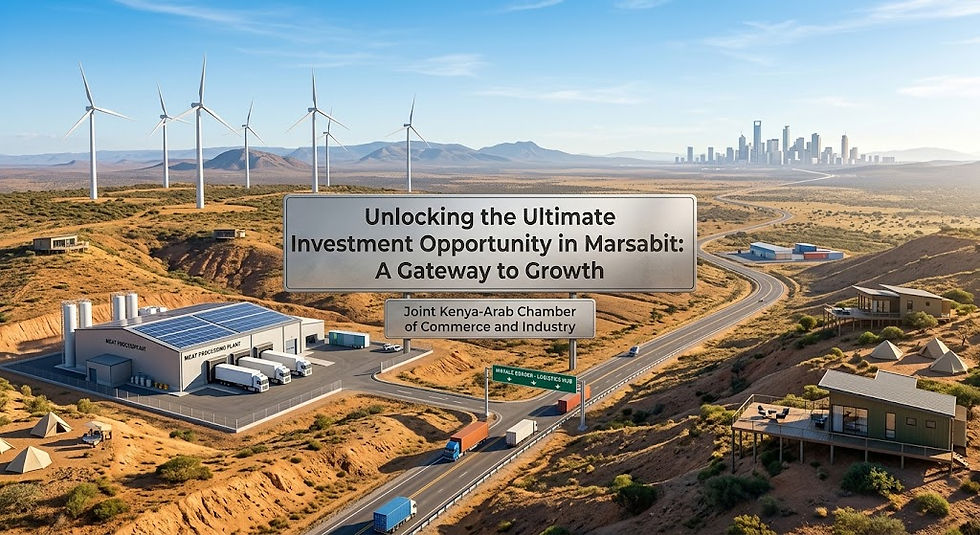
Across key sectors, #Economic_Growth remains closely linked to rising confidence among businesses, investors, exporters, and service providers. Kenya’s strategic location, diversified economy, entrepreneurial culture, and expanding infrastructure make it a natural gateway for regional and international business. For Arab investors and companies seeking access to East Africa, Kenya offers a stable and promising environment with opportunities in logistics, agriculture, construction, energy, manufacturing, tourism, digital services, education, healthcare, and real estate.
One of the strongest pillars of Kenya’s current business outlook is #Business_Confidence. Confidence grows when investors see clear demand, improving connectivity, active institutions, and a private sector that is ready to scale. Kenya has a strong base of small, medium, and large enterprises that understand local and regional markets. This creates opportunities not only for capital investment, but also for partnerships, joint ventures, technology transfer, franchising, and supply-chain development.
#Infrastructure_Development is another major driver of growth. Roads, ports, airports, energy systems, industrial zones, digital networks, and logistics corridors all help reduce the cost of doing business and improve market access. For Kenya-Arab cooperation, infrastructure is especially important because it links producers, importers, exporters, distributors, and consumers across borders. Better infrastructure means faster trade, stronger supply chains, and more attractive conditions for investors who want long-term value.
The growth of the #Private_Sector is central to Kenya’s economic future. Government policy can create an enabling environment, but businesses are the ones that create jobs, open markets, introduce innovation, and build commercial trust. Kenya’s private sector has shown resilience and adaptability, especially in services, finance, technology, logistics, agriculture, retail, and professional services. This provides a strong foundation for Arab and Kenyan companies to work together in practical, commercially meaningful ways.
For Arab investors, Kenya offers several advantages. It has access to a young and growing consumer market, a strong regional position within East Africa, and a business culture that is increasingly connected to international standards. For Kenyan businesses, Arab markets offer opportunities in export growth, investment attraction, tourism, food security partnerships, construction, finance, education, and innovation. These two directions of cooperation can create a balanced and mutually beneficial economic relationship.
The Joint Kenya-Arab Chamber of Commerce and Industry views #Investment_Opportunities not only as financial transactions, but as bridges between people, institutions, and markets. Investment succeeds when it is based on trust, transparency, cultural understanding, and shared long-term goals. This is why chambers of commerce play an important role: they connect the right partners, encourage market knowledge, support business delegations, and help companies move from interest to action.
Kenya’s economic outlook also benefits from regional integration. As trade routes, investment platforms, and African market frameworks continue to develop, Kenya is well positioned to serve as a hub for companies looking to expand across the continent. Arab businesses with experience in logistics, ports, finance, hospitality, energy, and infrastructure can find strong alignment with Kenya’s development priorities and market opportunities.
At the same time, Kenyan companies can use stronger Arab partnerships to reach wider markets, improve product standards, access new financing channels, and build export capacity. Sectors such as tea, coffee, fresh produce, meat, textiles, technology services, education, tourism, and professional training all have potential for deeper Kenya-Arab cooperation. With the right business matching and institutional support, these sectors can generate sustainable commercial value.
A positive investment climate is built step by step. It depends on reliable information, responsible business practices, clear communication, and strong networks. The role of JKACCI is to support this process by encouraging dialogue between investors, entrepreneurs, institutions, and trade partners. When business communities communicate regularly, confidence becomes stronger and opportunities become easier to realize.
Looking ahead, #Kenya_Arab_Trade can become an even stronger pillar of shared prosperity. The relationship between Kenya and Arab countries is supported by geography, history, trade routes, cultural links, and growing investor interest. The next stage should focus on practical implementation: more trade missions, sector-specific forums, investment roadshows, business-to-business meetings, and structured follow-up after every commercial engagement.
Kenya’s growth story is not only about numbers. It is about ambition, people, infrastructure, enterprise, and partnership. With continued confidence, responsible investment, and stronger private-sector cooperation, Kenya and the Arab world can build a future of shared economic progress.
For the Joint Kenya-Arab Chamber of Commerce and Industry, the message is clear: Kenya is open for business, Arab investors are valued partners, and the private sector has a central role in shaping the next chapter of growth.

Sources:
World Bank Kenya Economic Update and Kenya country outlook; African Development Bank Kenya economic profile; Reuters reporting on Kenya private-sector activity and growth outlook; U.S. Department of State 2025 Investment Climate Statements: Kenya.


Comments